Robbing the Bee Tree

Robbing the Bee Tree

by Angie Brown, Guest Author

Ken found a bee tree and asked us if we wanted them to cut the tree up for honey.  It’s an old tree, gnarled and lying on its side, so Ken felt justified in cutting it and taking some of the honey.  This opportunity was too inviting to turn down, so we agreed to go along. We were told to wear warm clothing and heavy shoes.  This was November in upstate New York, and the woods are chilly this time of year. Ken’s wife, Doris, had supper ready when we got to our rendezvous, their house.  After supper chores were finished, we began to layer our sweats and jackets on, putting on warm mittens too.

The three men walked ahead of us with a large lantern.  The two 12-year-old boys also carried a lantern, and the three teenage girls and three women trailed behind, grasping a shared lantern.  Watching our footing carefully, we walked through the grazing meadow – about a quarter of a mile – into the dark woods.  How quiet the woods were after dark.  I remember hearing the sound of a small animal scurrying through the leaves now and then.  Once, we were startled by the hoot of an owl.  And the pleasant smell of evergreens, moss, and old logs wafted through the air, completing the sensory experience as we walked along.

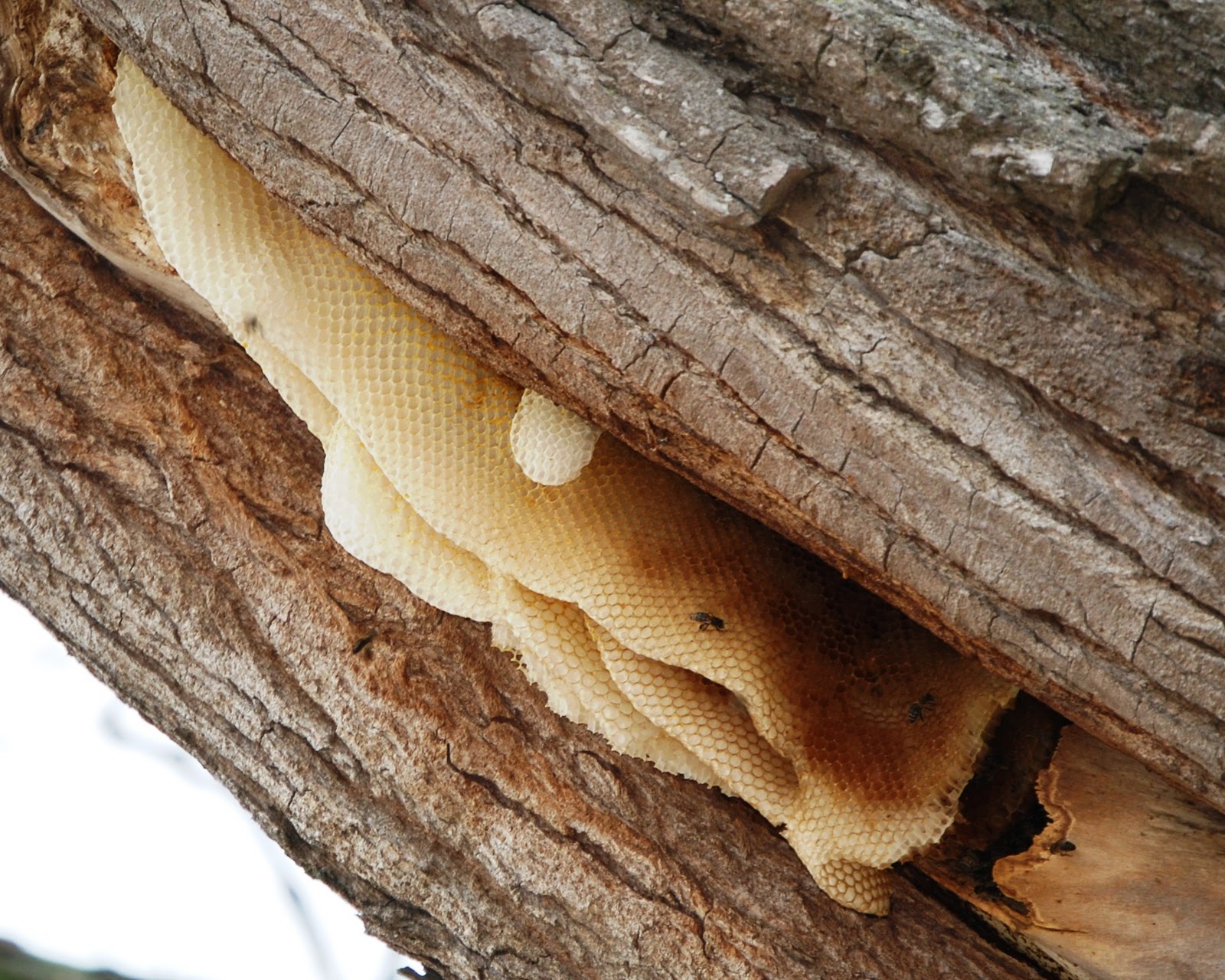
Reaching the old bee tree, the men prepared to get the sulfur going to calm the bees.  When the axe split the hard trunk, opening up the hive, we were amazed at the quantity of honey inside it.  This tree must have been home to the bees for many years.  Some of the bees moved around in a stupor, even crawling on the men’s clothing, but they were too lethargic to sting.  The inside of the tree was carpeted with layers of honey comb, a dark color near the wood and a gradually lighter color near the entrance to the hive.  We filled three pails with the combs, enough for each family.  And Ken made sure that there was plenty of honey left for the bees to survive the winter.

While the men worked on the cleanup, the girls began to feel cold, so the women decided we would go back to the house.  It was slow walking.  To make matters worse, the lantern carrier tripped, extinguishing the light.  Since we had no way of re-lighting the lantern, Doris said, “We’d better head for the road.” Almost everything was pitch dark, but looking up at the sky, we could distinguish between the tree line and the dim light of the sky.  That helped us to get our bearings. While we were making our way to the road, one of the bolder ones mentioned something about animals passing in the dark, inspiring us to walk faster. Before long, we had made it safely back to our rendezvous.

Doris made hot chocolate and brought out some cookies to go with it. Before long, we began to warm up.  The men finally came in with the pails of honey.  It is amazing how such small honeybees can amass such a bountiful delight.  (So it is with us, as we work together, how much we can accomplish.)  After our snack, we drove away exhilarated.  A walk in the woods at night can be an eventful and memorable experience, indeed!

After we got back home, I strained the honey and filled several jars to use in making cookies, breads, and desserts.  Wild honey has a unique taste, much different from clover honey, and stronger too.  If you would like to try your hand at making something with wild honey, I recommend the following:

Recipe for Honey Drops:

1 c. soft shortening (partly butter)

1 c. brown sugar

3 Tbsp. wild honey

3 Tbsp. white sugar

1 tsp. vanilla

3-1/2 c. flour

2 tsp. soda

2 eggs

Mix and chill thoroughly.  Form into balls the size of walnuts.  Bake on an ungreased cookie sheet for 10-12 minutes at 350 degrees Fahrenheit.  This makes about 40 cookies.

(For more articles by Angie Brown, click HERE)

God’s Perfect Timing

See the source image

God’s Perfect Timing

A True Story by Angie Brown

Colleen finished the letter she was writing, folded it and slipped it into an envelope.  Nearby lay her purse.  She reached into it and pulled out nine one-dollar bills.  This was all the money she had earned in three weeks.  She was only 14 years old and had taken a job at the lake, working for a young family with two children.  Her job was to take care of the children and do some housework.  For these responsibilities, her wages were three dollars a week, plus room and board.  She was excited about this wonderful opportunity to earn a little money.

She counted the money again to make sure she had taken all of it from her purse.  “I never had so much money in all my life,” she said to herself.  “I could buy some new clothes for school, notebooks and maybe one of those erasers with the rough edges to erase ink.”  For a few moments she felt very rich, but then she remembered what she was really planning to do with the money.  Seven brothers and sisters at home were in need. She felt a burst of joy and satisfaction as she stuffed the money into the envelope with the letter and sealed it.  Then, with a sense of accomplishment, she put the letter in the mail.

A few days later, and many miles away, Colleen’s mother, Dessy, was in her kitchen checking the cupboard.  “If I had some flour and yeast, I could mix up some bread dough to bake,” she thought, “or a bone for soup; but payday is three days away.” “Tell me what to do, Lord” she prayed.

Then she walked out into the back yard and began taking the freshly dried laundry off the clothes line, still praying.  After filling her arms with a load of clothes, she walked back into the kitchen and heard the sound of footsteps on the front porch.  She laid the clothes down and walked to the front door, just as the mailman was leaving.  “Oh,” she said to herself, taking the mail out of the box, “a letter from Colleen.  I’m so glad she has this opportunity to work at the lake.”  Colleen and the two older children were a big help to her at this particular time.

As she opened the letter to read it, a bunch of bills fluttered out.  When she had read Colleen’s letter and counted the nine one-dollar bills, she exclaimed, “She…she has sent me all the wages she has earned!”  Dessy’s cheeks were drenched with tears as she thanked God over and over for answered prayer. So, with money in hand, she left immediately for the grocery store.

Later, when Colleen’s employer learned that she had risked sending cash in a letter, she was concerned.  “You know, you took a big chance sending the money that way”, she said. Colleen paused for a moment and then replied “Oh, I knew it would get there. It was needed at home.”

Isn’t that a beautiful example of how God answers prayer and provides for the needs of His own people? And just in time, too!  His timing is perfect, isn’t it?

(For more articles by Angie Brown, click HERE)

Winter’s a Comin’

Firewood under stairs

Winter’s a Comin’

A Poem by Angie Brown, Guest Author

The apples are picked

Potatoes dug

The leaves all raked

And the wood all lugged.

The storm sash set in

Woolens brought out

The quilts repaired

For winter’s long bout.

Shovels are ready

Car anti-freezed

Fam’ly prepared

For Winter’s cold breeze.

(For more articles by Angie Brown, click HERE)

Mrs. Butterworth Teaches a Lesson

A maple syrup tapMrs. Butterworth Teaches a Lesson

By Angie Brown, Guest Author

This true story took place many years ago in a small town on the outskirts of Olean in western New York State. One spring day, on his way home from school, my 10-year-old son, Leo, noticed all the pails hanging on the sugar maple trees to collect fresh sap that was to be boiled down to make maple syrup.  He rushed into the house, saying, “Hey, Mom, let’s make some maple syrup, OK?” Now, the making of maple syrup was not exactly one of my priorities, mind you, but I didn’t want to squelch his enthusiasm. So, I thought, “Why not?  We could give it a try.  It might be fun.” And so, the ill-fated plan was hatched.

We waited until the following Saturday morning. Then, Leo borrowed his father’s drill and made holes in several nearby sugar maple trees.  Inserting the spouts and pounding in nails to hold the collecting pails, he was now ready for the sap to start running. Sure enough, it wasn’t long before we had enough sap to start with. So we collected the sap from all of our pails into one larger container, strained the impurities out and poured the sap into my canning kettle.  Setting it on the stove, we fired up the burner and began to envision delicious, homemade maple syrup for our pancakes. What a special treat that was going to be! Or so we thought.

The sap simmered slowly for several hours, and I wondered, “Why do people go to all the trouble of making a fire outside in a well-ventilated sugar shack, getting cold and standing around all bundled up, when it was so easy to do it right in the comfort of your own kitchen?” Then I went about my housework while the boiling continued.  I checked the kettle periodically and noticed that the boiling sap was just beginning to change to a very light brown color, characteristic of a high-grade maple syrup.  “We’ll soon have some maple syrup,” said Leo excitedly, rubbing his hands together and licking his chops.

But a little later, when I walked into the living room, our eager anticipation turned into alarm. I noticed a large, wet spot on the ceiling; then another and another! Then I noticed that the same thing was happening in the adjoining dining room too! Suddenly, a light went on in my head. That must be the reason for using the sugar shack; it allows the water vapor from the sap to escape through the vents, instead of condensing on the ceiling. In a panic, we stopped the boiling immediately, to prevent further damage to our ceilings; so much for our homemade maple syrup!

That day both mother and son learned a valuable lesson by trial and error; a little bit of knowledge can be a dangerous thing.  And we had plenty of time to let this little lesson sink in, as we waited anxiously for the wet spots on our ceilings to dry. I sure hope Mrs. Butterworth wasn’t watching!

(For more articles by Angie Brown, click HERE)