The Season’s Touch

See the source image

The Season’s Touch

By Angie Brown, Guest Author

The unshaven elderly man, dressed in a double layer of overcoats, a woolen knit hat pulled snugly over his ears, and black unbuckled overshoes, stood on the corner of a busy main street. He was standing with his back close to the massive building where the throng of people were coming and going near the double door entrance. The woolen mittens covering his hands held a songbook. It was the Christmas season and he stood erect, singing lustily, in a deep haunting voice. What was so unusual was that he was not asking for a deed of mercy. He was singing with delight, as could be seen from the joy on his face. Occasionally, he picked up his small violin and brought forth a sweet musical arrangement while he sang. His excellent baritone voice was noticed, and the moving crowd slowed its pace as they approached.

Alex Kallenbach, the vice president of Maier, Jones and Kallenbach law firm, was hurrying from the parking ramp to his office on the fourth floor of the building. He had observed the elderly gentleman before, but this morning, as he looked at the singer, he stopped and listened. He engaged him in conversation. The singer pulled his mittens off and flipped through a few pages of his book, and said, “Here’s a favorite. Would you like to hear it”? “Sure,” was the reply. As the strong, low-pitched voice started “We Three Kings”, Alex joined in and finished the song with the stranger. They laughed, shook hands and Alex thanked him, going through the doors of the building. “Good morning,” Alex sang the greeting, happily seating himself at his desk. His partners took a moment to look in his direction. “A.K. must be in a rather good frame of mind today,” they thought. The day passed swiftly and surprisingly well.

The next morning, there he was again at the corner, the violin was sending out its message, and again the glow on the singer’s face was evident. Alex stopped beside the stranger and joined in with “Joy to the World.” He was having so much fun that he continued singing the next Christmas song as well. Finishing that, he picked up his briefcase and walked the four flights of stairs to his office instead of taking the elevator. He wanted a few more minutes to bask in the atmosphere of the lightness he felt.

All week long, Alex was filled with energy and enthusiasm. Every morning, he sang with the stranger. His zeal was contagious. Others observed the new attitude as they worked. The clerks next door in the advertising offices walking by heard the jovial tone coming from the law office and wondered what was going on. At the end of the lengthy hall in the medical office, the secretary mentioned, “There’s a whole new air on this fourth floor.” By the end of the week, she too found herself happily encouraging the patients who came in.

Every door on the fourth floor was dressed in fresh evergreens with bright, red ribbons. This year, all the offices in the building were having a party together in the restaurant on the ground floor. The morning of the party, Alex, as usual, accompanied the singing gentleman with a few carols and then he said, “Sir, you are a trained baritone. Surely you’ve been singing before, haven’t you?” “Oh, yes,” was the answer. “I’d like to invite you to our Christmas party this afternoon at five p.m. Bring your violin,” said Alex. The man smiled a grateful “Thank you,” as the lawyer entered the building.

Alex mentioned the stranger to the others, and it was decided that the collection they usually take to benefit some needy person should be given to the singer. At five o’clock, the party was in full swing when they heard the sweet strains of “O Holy Night” coming from the hallway. Opening the door, the crowd found no one there, but the old violin was there, with a note tucked into the strings which read: “Wise Men Still Seek Him.”

(For more short stories by Angie Brown, click HERE)

New Theory: Homosexuality Is a Mistake of Nature

See the source image

New Theory: Homosexuality Is a Mistake of Nature

James R. Aist

Introduction

Homosexuality is believed to be caused by some combination of biological and environmental factors. Several biological theories have been offered, the most feasible being the genetic, the hormonal and the epigenetic theories. In 2012, a new theory was introduced that combines aspects of the genetic theory with the hormonal theory. This is the epigenetic theory. Epigenetics is a relatively new and vigorously investigated field of biological science that deals with the regulation of gene expression (production of proteins) in cells. The components of chromosomes that regulate genes are called “epi-marks.” These include such things as methylated DNA and variously modified histone proteins, but do not include changes in the DNA sequences themselves that code for specific proteins.

The Theory

Rice et al. (2012) published a review article presenting a speculative and hypothetical model (theory) to explain the development of homosexuality in both male and female homosexuals. Their goal was to develop a model that would explain why 1) molecular studies have failed to conclusively identify “gay genes” and 2) concordance for homosexuality between identical twins is low (click HERE). The theory draws on research supporting the hormonal theory as well as known properties and functions of epi-marks. The model would explain homosexuality on the basis of epi-mark-controlled prenatal testosterone (a sex hormone) levels, to the virtual exclusion of a role for either a strictly genetic influence or post-natal environmental influences.

Normally, epi-marks regulating sexual orientation are “erased” after they have produced the intended sexual development (i.e., heterosexual males and females). But, occasionally, a mistake is made, and the epi-mark is not erased but is, instead, passed on to the next generation. According to the model, when this mistake is made, epi-mark regulated testosterone overexposure in a female fetus would result in a masculinized female who will prefer females (a lesbian), whereas epi-mark regulated testosterone underexposure in a male fetus would result in a feminized male who will prefer males (a gay). The low concordance in twin studies would be explained not by a low-level genetic influence, as is usually assumed, but by the occasional passing of testosterone-enhancing epi-marks from father to daughter (creating a lesbian) and of testosterone-limiting epi-marks from mother to son (creating a gay man).

It is interesting to note that this model posits homosexuality as an aberrant accident of nature, in which normal prenatal development of a fetus produces the intended effect (heterosexuality), and abnormal prenatal development produces an unintended effect (homosexuality) by mistake. Abnormal prenatal development results when a mistake is made and an epi-mark in a parent is not erased, but is, instead, passed on to the offspring, where its effect (homosexuality) is seen in the subsequent generation. Thus, according to this theory, homosexuality is a mistake of nature, and it is not biologically normal, as gay activists want us to believe.

Although this model is highly speculative and presently has very little, if any, direct experimental support, it does have merit as a scientific hypothesis, because 1) it would explain both male and female homosexuality, 2) it could explain the low concordance for homosexuality found in twin studies, 3) it seems to provide a feasible explanation for the long-term survival of a reproductively deleterious trait in the human population, and 4) it is, at least to some extent, testable. Only further research will determine whether or not this theory will join the many previous theories purporting to represent an almost exclusive influence on the development of homosexuality, all of which have failed.

Caveat

Twin studies have shown that the combined influence of all possible, pre-natal, biological factors (e.g., genetics, epigenetics, hormones, etc.) on the development of homosexuality in adults is only weak to weakly moderate (click HERE). Thus, post-natal influences (e.g., cultural, social and experiential factors) are far more influential than is epigenetics in the development of homosexuality (click HERE).

Reference Cited:

Rice, G., et al. 2012. Homosexuality as a Consequence of Epigenetically Canalized Sexual Development. Quarterly Review of Biology 87:343-368.

(For more articles on HOMOSEXUALITY, click HERE)

Spontaneous Change in Sexual Orientation: It Does Happen!

See the source image

Spontaneous Change in Sexual Orientation: It Does Happen!

James R. Aist

(Note: Numbers in parentheses refer to references listed at the end of the article)

Introduction

Pro-gay activists are doing their best to deny that therapy and counseling for people with unwanted homosexuality can be effective. This is not because it can’t be effective (it can), but because to admit that it can be effective would undercut the goal of the “gay agenda” to convince the heterosexual majority that homosexual people are “born gay” and, therefore, cannot change. But the fact is that not only can therapy and counseling be effective in helping people diminish or remove homosexuality from their lives, such change often occurs spontaneously, without any intervention being necessary or even attempted; it just happens.

The Details

A huge amount of information on this topic has been reviewed and summarized by Whitehead and Whitehead (1), which I will excerpt as follows:

Large studies now show that…

For adolescents:

[The following points were derived by Whitehead and Whitehead (1) from the data files used by Savin-Williams and Ream (2).]

  • Most teenagers who identify as homosexual will change from same-sex attraction. In fact, in the 16 to 17 year age group, 98% who identified initially (at age 16) as homosexual or bi-sexual had moved towards heterosexuality one year later, at age 17;
  • 16 year olds saying they are same-sex attracted or bi-sex attracted are 25 times more likely to say they are opposite sex attracted at the age of 17 than those with a heterosexual orientation are likely to identify themselves as bi-sexual or homosexual; and
  • 16-year olds who claim they are opposite sex attracted will overwhelmingly remain that way.

For adults:

  • About half of those with exclusive same-sex attraction move towards heterosexuality over a lifetime. Put another way, 3% of the practicing heterosexual population (both men and women) claim to have once been either bisexual or homosexual;
  • These changes are not therapeutically induced, but happen “naturally” in life, some very quickly;
  • The vast majority of changes in sexual orientation are towards exclusive heterosexuality;
  • The number of people at any point in time who have changed spontaneously towards exclusive opposite sex attraction are greater than the number of bisexuals and exclusive same-sex attraction people combined. In other words, “Ex-gays outnumber actual gays”; and
  • Exclusive opposite sex attraction is 17 times as stable as exclusive same-sex attraction for men, and 30 times as stable as exclusive same-sex attraction for women. (Women are known to be more fluid in their sexual orientation than are men.)

Additionally, Sorba (3) has documented numerous examples of adult celebrities and homosexuality advocates who have spontaneously changed from homosexual to heterosexual. These include celebrities such as pop star Sinead O’Connor, actress Ann Heche, gay activist/author Jan Clausen and gay activist Williams (Bro) Broberg. Furthermore, at least six specific examples of adults who changed sexual orientation spontaneously, without therapy or counseling, have been documented by NARTH (4). These documented examples of spontaneous changes demonstrate the considerable fluidity that exists in sexual orientation for many individuals, even in adulthood.

Conclusions

Sexual orientation is often fluid, not fixed, and change sometimes occurs spontaneously, without formal intervention of any kind. The vast majority of spontaneous change in sexual orientation is from homosexual to heterosexual. In fact, it can be accurately stated that ex-gays outnumber actual gays at any given time. These documented facts demonstrate that at least a considerable number of homosexuals are not “born gay.” And they lend credence to the many reports that therapy and counseling for unwanted homosexuality can be effective: since sexual orientation sometimes changes spontaneously, it follows that formal efforts to assist an individual with unwanted homosexuality would, indeed, be quite effective, and they can be (click HERE)

References Cited:

1. Whitehead, N. and B. Whitehead. 2016. My Genes Made Me Do It! – Homosexuality and the Scientific Evidence. Chapter 12. Can sexual orientation change? (click HERE)

2. Savin-Williams, R., and G. Ream. 2007. Prevalence and Stability of Sexual Orientation Components During Adolescence and Young Adulthood. Archives of Sexual Behavior 36:385-394.

3. Sorba, R. 2007. The Born Gay Hoax. (click HERE)

4. NARTH, 2012. 7) Spontaneous or Adventitious Change of Sexual Orientation. (click HERE)

(For more articles on HOMOSEXUALITY, click HERE)

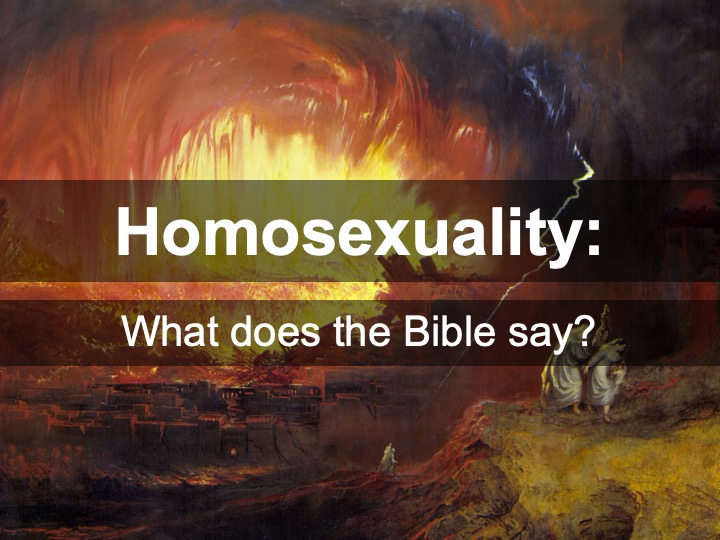
An Easy, Do-It-Yourself Bible Study on Homosexuality

See the source image

An Easy, Do-It-Yourself Bible Study on Homosexuality

James R. Aist

Introduction

If you’ve been paying attention to the “gay agenda’s” assault on the Christian church lately, you’re familiar with their attacks on the reliability and veracity of English translations of the Bible. Proponents of the recently invented “gay theology” (click HERE) and the “gay gospel” (click HERE) claim, for example, that the Bible doesn’t really condemn homosexuality, that the English translations have wrongly portrayed what the ancient Hebrew and Greek manuscripts really say about the matter and that the references to homosexuality in the Bible do not apply to modern homosexual couples in long-term, committed, exclusive and loving relationships. The latter claim is used in an attempt to validate, justify and rationalize so-called “gay marriage.”

Historically, the common, ordinary Christian has had to leave the study of the Hebrew and Greek used in the ancient manuscripts of the Bible to highly trained Bible scholars and translators. But, in recent years, user-friendly computer software has been developed that enables the computer literate to study the Bible at this level without first becoming Hebrew and Greek scholars themselves. So, here’s how to do your own study of the Hebrew and Greek root words used in the Bible to express God’s views on homosexuality, using authoritative and reliable Hebrew and Greek lexicons. “It’s so easy, a cave man can do it.”

The “Cook Book” Procedure

To conduct your own, personal study: 1) find online, and open, “Strong’s Exhaustive Concordance” at “biblestudytools.com” (click HERE); 2) follow the instructions given in the introductory pane; 3) enter, in turn, the following Bible passages  — Genesis 19:1-11 with Jude 1:7; Leviticus 18:22; Leviticus 20:13; Romans 1:26-27; I Corinthians 6:9-10; and I Timothy 1:10 – and then; 4) for each Bible passage, click on the respective highlighted words (hyperlinks) to access the appropriate lexicon and read the meaning of the Hebrew or Greek words, given in English. You can toggle between the King James Version (KJV) and the New American Standard (NAS) version and still retain the Strong’s Numbers; or, you can choose from a dozen or more other English translations and read the passage without Strong’s Numbers. You will find, as expected, that wherever homosexual behavior is mentioned in the Bible, it is consistently condemned as sin, abomination, perversion, etc. And understand that translators of later English versions of the Bible, such as the NIV and NAS, consulted the ancient Hebrew and Greek manuscripts, rather than simply putting the KJV into modern English.

You may also find it helpful to read the following, most excellent and enlightening, short articles concerning the Bible and homosexuality, as part of your study:

Allen, J. 2014. The Apostle Paul and Homosexuality—Answering Homosexual Objections (Part 1) (click HERE)

Allen, J. 2014. The Apostle Paul and Homosexuality—Answering Homosexual Objections (Part 2) (Click HERE)

Conclusions

The claims of gay activists — that the Bible doesn’t really condemn homosexuality as sin, that the English translations have wrongly portrayed what the ancient Hebrew and Greek manuscripts really say about the matter and that the references to homosexuality in the Bible do not apply to modern homosexual couples in long-term, committed, exclusive and loving relationships — is nothing but pure fantasy and wishful thinking, as you can see for yourself. Therefore, the Bible cannot be used with honesty, accuracy and integrity to justify and rationalize so-called “gay marriage.”

(For more articles on HOMOSEXUALITY, click HERE)