Homosexuality: Religiously Mediated Change

See the source image

Homosexuality: Religiously Mediated Change

James R. Aist

Contrary to the fallacious claims of gay activists, homosexual people can change their sexual orientation if sufficiently motivated, as evidenced by numerous personal testimonies (click HERE). I have briefly reviewed such change resulting from secular counseling and therapy (click HERE). In the present article, I focus on religiously mediated change, which has been around for a very long time and has been scientifically documented, as you will see. (Note: numbers in parentheses refer to numbered references at the end of the article.)

It’s important to realize, at the outset, that the God of the Bible wants to change homosexual people Himself, through the “name” (i.e., the power and authority) of Jesus Christ, as recorded in the Bible (I Corinthians 6:9-11)! Interestingly, this is probably the first-ever published report of homosexual transformations. Now, Paul was well aware that the condition of homosexuality has two aspects: 1) same-sex attractions (SSA), which he described as “shameful lusts” and “inflamed with lust for one another” (Romans 1:26-27); and 2) the practice of homosexuality (Romans 1:26-27 and 1 Corinthians 6:9). Thus, when Paul states “…that is what some of you were”. But you were washed…” (1 Corinthians 6:9-11), he is not just speaking about the abandoning of homosexual practice (celibacy), but also the cessation of SSA. On the other hand, Paul did not say whether or not these particular transformed homosexual people became heterosexual. Moreover, Jesus himself wants homosexual people to be changed, else why would these Corinthian homosexual people have been changed through His power and authority? Jesus did not come to save us and our sins, but to save us from our sins.

More recent examples exist of religiously mediated change from a homosexual to a heterosexual orientation (1, 2). Here are some specifics of one of these studies. Pattison and Pattison (3) conducted a scientific study of 11 men who changed from exclusive and active homosexuality to exclusive or almost exclusive heterosexuality after converting to Christianity in a Pentecostal church fellowship. On the Kinsey 7-point sexual orientation scale, all subjects manifested major before-after changes. Eight of the 11 subjects became exclusively heterosexual. Although the men participated in prayer groups with heterosexual men and women, no effort was made to effect the change of sexual orientation. NARTH (4) has listed 24 autobiographies and 14 case histories of homosexual people who have undergone religiously mediated change from homosexual to heterosexual. Jones and Yarhouse (5) conducted a scientific study that was designed to meet high standards of empirical vigor and is perhaps the best scientific publication to date in this regard. They studied 61 subjects who completed the study, which included six independent assessments over a total time span of 6-7 years. Standardized, respected measures of sexual orientation were used. Of the 61 subjects, 23% reported successful conversion to heterosexual orientation and functioning, while another 30% reported stable behavioral chastity with substantive dis-identification with homosexual orientation. Moreover, there was a statistically significant increase of heterosexual attraction. The authors concluded that their results demonstrate meaningful shifts along a continuum that constitute real changes for some of the subjects. For comparison, a success rate of around 25%-30% is generally achieved by therapists and counselors for psychological disorders and behavioral problems, such as alcoholism (6, 7, 8).

Restored Hope Network is a membership-governed network dedicated to restoring hope to those broken by sexual and relational sin, especially those impacted by homosexuality. They proclaim that Jesus Christ has life changing power for all who submit to Christ as Lord; they also seek to equip the church to impart that transformation. Their website (click HERE) is able to connect many with a nearby ministry that will offer help in overcoming homosexuality. Also, P.A.T.H. (click HERE) has a list of religious and secular organizations and ministries offering help for dissatisfied homosexuals seeking change. I can also recommend two online resources that will enable almost anyone, anywhere, to obtain Christ-centered help in overcoming unwanted homosexuality: Taking Back Ground (click HERE)  and  Reach Truth (click HERE).

References Cited:

  1. NARTH, 2012. 6) Religiously Mediated Change. (click HERE)
  2. Phelan, J.E., N. Whitehead and P.M. Sutton. 2009. What Research Shows: NARTH’S Response to the APA Claims on Homosexuality. Journal of Human Sexuality, Volume 1, Pages 9-39. (click HERE)
  3. Pattison, E.M. and M.L. Pattison. 1980. “Ex-Gays”: Religiously Mediated Change in Homosexuals. American Journal of Psychiatry 137:1553-1562.
  4. NARTH. 2012. Autobiographies of Religiously Mediated Change. (click HERE)
  5. Jones, S. L. and M.A. Yarhouse. 2011. A Longitudinal Study of Religiously Mediated Sexual Orientation Change. Journal of Sex and Marital Therapy 37:404-427.
  6. Whitehead, N. and B. Whitehead. 2016. My Genes Made Me Do It! – Homosexuality and the Scientific Evidence. Chapter 12. Can sexual orientation change? (click HERE)
  7. Socarides, C.W. 1995. Homosexuality: A Freedom Too Far. Adam Margrave Books, Phoenix AZ.
  8. Satinover, J. 1996. Homosexuality and the Politics of Truth. Hamewith Books/Baker Books, Grand Rapids MI.


(For more articles on HOMOSEXUALITY by Dr. Aist, click HERE.)

Homosexuality: Secularly Mediated Change

See the source image

Homosexuality: Secularly Mediated Change

James R. Aist

“Truth is not arrived at by wishful thinking or vacuous argument. It comes, instead, by careful examination of factual evidence.”

A comprehensive history of this topic was published by Phelan, et al. (1), and numerous personal testimonies of change are available online (click HERE). Many professional therapists have reported the clinical results of their own efforts to help dissatisfied homosexuals to change. The results presented by Socarides (7) seem to be representative of successful treatment therapy. Out of around 1,000 dissatisfied male homosexuals, about 35% became heterosexual (able to have complete, satisfactory sex with a woman and develop the capacity to really love her). Another 31% were able to control previously uncontrollable impulses toward same-sex sex (abstinence). The remaining 34% discontinued treatment for various reasons.

Satinover (2) compiled the results of nine outcome studies of clinical results reported in the 1950s through the 1980s. Out of a total of 341 dissatisfied homosexuals treated, success rates varied from 27% to 100%, where success was defined “as considerable to complete change.” In these reports, the average success rate was 52%. A range of reported success rates often reflects varying degrees of success with different therapy approaches; some approaches and some therapists are more effective than others.

Individual therapists have also reported long-term success in homosexual to heterosexual changes. Masters and Johnson (3) reported that 71.6% of their transformed homosexual subjects were still heterosexual after five years (when the study was terminated), indicating that these sexual orientation transformations represented long-term changes. Mayerson and Lief (4) found that 47% of their patients were functioning heterosexually after a mean follow-up period of four and a half years. And some transformed homosexuals were reported to have remained exclusively heterosexual for as long as 20 years (5)!

Surveys and meta-analyses also show the reality of secularly mediated change. Bieber et al. (6) is a good example. Out of 106 homosexual men in the studies they reviewed, 35 (33%) changed to exclusively heterosexual. And in a follow-up study conducted three years later on 15 of these formerly exclusively homosexual men (all those for whom data could be reclaimed), Socarides (7) found that 12 (80%) had remained exclusively heterosexual. Clippinger (8) reported similar results from 12 independent studies. Of 785 patients, 307 (38%) were “cured” (i.e., changed from homosexual to heterosexual). Goetze (9) conducted a carefully designed meta-analysis of the results of 17 studies. He determined Kinsey ratings before and after therapy and obtained follow-up information. Of 396 subjects who were exclusively or predominately homosexual, 283 (71.5%) experienced a partial shift in sexual orientation, 69 (17.4%) acquired heterosexual behavior and 44 (11.1%) experienced a full shift to heterosexual orientation. Thus, 28.5% (17.4% + 11.1%) became exclusively or predominately heterosexual.

Again, a success rate of around 25%-30% is generally achieved by therapists and counselors for psychological disorders and behavioral problems, such as alcoholism (2, 7, 10).

The National Association for the Research and Therapy of Homosexuality (click HERE) is a professional, scientific organization that offers hope to those who struggle with unwanted homosexuality. They have extensive published resources available and can provide referrals to treatment programs and professional, experienced therapists who also can provide compassionate guidance and support to help dissatisfied homosexual people in their journey out of homosexuality.

Conclusion: Despite the vacuous denials of gay activists and their heterosexual supporters, there is more than enough clinical evidence to establish the fact that professional, secular treatment of unwanted homosexuality can be successful at a rate comparable to that for psychological disorders and for behavioral problems, such as alcoholism.

(For more articles on HOMOSEXUALITY by Professor Aist, click HERE)

References Cited:

  1. Phelan, J.E., N. Whitehead and P.M. Sutton. 2009. What Research Shows: NARTH’S Response to the APA Claims on Homosexuality. Journal of Human Sexuality, Volume 1, Pages 9-39. (click HERE)
  2. Satinover, J. 1996. Homosexuality and the Politics of Truth. Hamewith Books/Baker Books, Grand Rapids MI.
  3. Masters, W. H. and V. E. Johnson. 1979. Homosexuality in Perspective. Little, Brown & Co., Boston.
  4. Mayerson, P., and Lief, H. 1965. Psychotherapy of homosexuals: a follow-up study. In, Sexual Inversion: The Multiple Roots of Homosexuality, ed. J. Marmor. New York: Basic Books.
  5. Bieber, I. and T.B. Bieber. 1979. Male Homosexuality. Canadian Journal of Psychiatry 24: 409-421.
  6. Bieber, I., et al. 1962. Homosexuality: A Psychoanalytic Study of Male Homosexuals. Basic Books, New York.
  7. Socarides, C.W. 1995. Homosexuality: A Freedom Too Far. Adam Margrave Books, Phoenix AZ.
  8. Clippinger, J. 1974. Homosexuality can be cured. Corrective and Social Psychiatry and Journal of Behavior Technology Methods and Therapy. 21:15-28.
  9. Goetze, R. 1997. Homosexuality and the Possibility of Change: A Review of 17 Published Studies. Toronto Canada: New Directions for Life.
  10. Whitehead, N. and B. Whitehead. 2012. My Genes Made Me Do It! – Homosexuality and the Scientific Evidence. Chapter 12. Can sexual orientation change? (click HERE)

What Biological Theories of Homosexuality Cannot Explain

See the source image

What Biological Theories of Homosexuality Cannot Explain

James R. Aist

(Note: References are cited by number in parentheses and appear at the end of the article)

“Truth is not arrived at by wishful thinking or vacuous argument. It comes, instead, by careful examination of factual evidence.”

Since the early 1970s, gay activists have increasingly claimed that they were “born gay” and that, therefore, they could not change even if they wanted to. By repeating this claim over and over again for decades now, gay activists have managed to win over a large percentage of heterosexual “believers” to their cause, without any substantial basis in fact to validate the claim that they were “born that way.” “Born gay” is, in fact, a hoax of mammoth proportions. Therefore, it is necessary to examine carefully the facts concerning the origins and development of homosexuality to see if there is any truth at all to the “born gay” claim. Most of the relevant information can be grouped into two main categories: biological theories and social and environmental influences. The critical question is whether homosexuality is already determined at birth by biological factors and is immutable (unchangeable), or develops later as a result of post-natal experiences and influences during childhood.

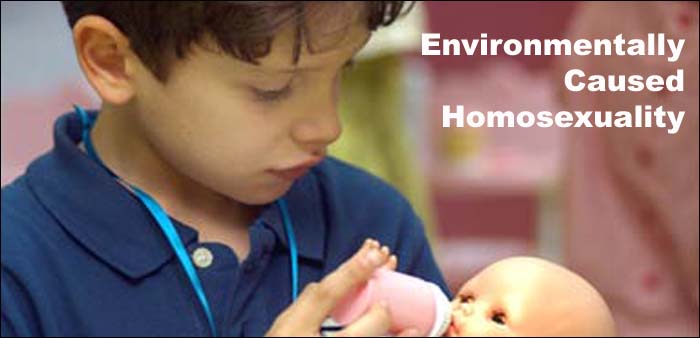
There are several social and experiential factors that have been shown to play an important role in the development of homosexuality. Let’s take a quick look at a few of these post-natal factors, which cannot be explained by biological theories:

Childhood sexual abuse has been shown to be associated with the subsequent development of homosexuality in adulthood. Whitehead (8) lists eight relatively recent studies demonstrating this association. For example, in the article by Zeitsch, et al. (10), childhood sexual abuse was associated with an approximately two to three-fold increase in homosexuality in adulthood.

Divorce during childhood has also been shown to be associated with the development of homosexuality in adulthood, as evidenced by homosexual “marriage.” For example, men whose parents divorced before their sixth birthday were 39% more likely to “marry” homosexually than peers from intact parental marriages, and the figure for men whose cohabitation with both parents ended before age 18 years was in the range of 55%-76% (4). In a related study, Wells, et al., (7) found that cohabiting with two heterosexual, non-biological parents until the age of 16 was associated with a two-fold increase in homosexuality in adulthood, compared to cohabiting with both biological parents.

Urban versus rural environment. Whitehead and Whitehead (9) pointed out that the percentage of homosexuality in males reared in urban environments is 3.3 times that of males reared in rural environments, while the corresponding factor for homosexuality in females reared in urban environments is 2.3 times, indicating a very strong influence of the urban environment, as opposed to the rural environment, on the development of homosexuality.

Homosexual parents. Schumm (5) found that adults with a homosexual parent are 12 to 15 times as likely to self-identify as homosexual or bisexual as are adults without a homosexual parent, which indicates that post-natal environmental factors associated with having a homosexual parent (such as having a homosexual adult role model and unequivocal acceptance of homosexuality in the home) can play a major role in the development of a homosexual orientation. These results confirmed those of an earlier, much aligned (by gay activists), meta-analysis conducted by Cameron (3), and they suggest a very powerful post-natal influence on the development of homosexuality.

Therapy and Counseling Influences. Aist (1) reviewed and summarized some of the published information on religiously mediated and secularly mediated change in sexual orientation from homosexual to heterosexual. Numerous studies have shown that both religiously and secularly mediated change in sexual orientation occurs in highly motivated, dissatisfied homosexuals at a rate that is comparable to the success rates generally achieved by therapists and counselors for psychological disorders and behavioral problems, such as alcoholism. And many studies have found that, for the most part, these are long-term, stable shifts in sexual orientation. In fact, many ex-gays have been happily married with children for several-to-many years. What is the significance of these results relative to the claim that homosexual people are born gay? First, they confirm that pre-natal influences, including genes, do not dictate sexual orientation, because very significant change in sexual orientation has been achieved through therapy and counseling. Such change would not be possible if sexual orientation were fixed at birth. And second, the fact that therapy and counseling are successful at a rate that is comparable to the success rates generally achieved by therapists and counselors for psychological disorders and behavioral problems, such as alcoholism, confirms that any predisposition to homosexuality that may be present at birth is so weak that it can be nullified by subsequent intervention. Socarides (6) put it this way: “As psychoanalysts and psychotherapists, we are treating obligatory homosexuality successfully, changing sexual orientation from homosexual to heterosexual. Such a change would be unthinkable if there were any truth at all to the organic or biological or hereditary causation of homosexuality.”

It is virtually impossible to envision how prenatal mechanisms could explain these post-natal associations of increased or decreased homosexuality that correlates with social and experiential factors. But it is easy to envision how these factors could account for the two-thirds or more of post-natal influence on homosexuality that is revealed by the results of twin studies (2).

References Cited:

  1. Aist, J. 2012. Homosexuality: Good News!(click HERE)
  2. Aist, J. 2014. What Twin Studies Tell Us About Homosexuality: Nature vs. Nurture (click HERE)
  3. Cameron, P. 2006. Children of homosexuals and transsexuals more apt to be homosexual. Journal of Biosocial Science 38:413-418.
  4. Frisch, M. and A. Hviid. 2006. Childhood Family Correlates of Heterosexual and Homosexual Marriages: A National Cohort Study of Two Million Danes. Archives of Sexual Behavior 35:533-547.
  5. Schumm, W. 2010. Children of Homosexuals More Apt to be homosexuals? A Reply to Morrison and to Cameron Based on an Examination of Multiple Sources of Data. Journal of Biosocial Science 42:721-742.
  6. Socarides, C.W. 1995b. Exploding the myth of constitutional homosexuality. Narth Bulletin, Vol. III, Number 2, pages 17-18.
  7. Wells, J.E., et al. 2011. Multiple Aspects of Sexual Orientation: Prevalence and Sociodemographic Correlates in a New Zealand National Survey. Archives of Sexual Behavior 40:155-168.
  8. Whitehead, N. 2012. Book Review of Simon LeVay’s Gay, Straight and the Reason Why. (click HERE)
  9. Whitehead, N. and B. Whitehead. 2012. Chapter 2. The genetic implications of SSA population percentage. (click HERE)
  10. Zietsch, B., et al. 2012. Do Shared Etiological Factors Contribute to the Relationship between Sexual Orientation and Depression? Psychological Medicine 42:521-532.

(For more articles by Dr. Aist on homosexuality, click HERE.)


God Does Not Make Anyone Homosexual!

Image result for homosexual free images

God Does Not Make Anyone Homosexual!

James R. Aist

 “For the time will come when people will not put up with sound doctrine. Instead, to suit their own desires, they will gather around them a great number of teachers to say what their itching ears want to hear. They will turn their ears away from the truth and turn aside to myths” (2 Tim. 4:3-4).

Introduction

In a separate article (click HERE), I have gone into considerable detail to show that “born gay” is a monumental myth being perpetrated by gay activists in a vain attempt to validate and legitimize homosexuality. Many so-called “gay Christians” claim further that homosexual people are not only born gay, but that God created them that way (with same-sex attractions). The implication is that, since God made them “that way”, both their homosexuality and their practice of homosexuality should be fully accepted and celebrated by Christians and the Christian church as a “gift from God.” So, let’s take a closer look at the Scriptures and see if we can discern the truth: are same-sex attractions from God, and, if not, where do they come from?

Same-sex Attractions Are Not from God

The claim that same-sex attractions are a gift from God is diametrically opposed to the biblical witness; there are scriptural proofs that God is not the source of the same-sex attractions and desires that homosexual people experience. Firstly, the Bible clearly and consistently condemns homosexual behavior, in any context, as sin (Genesis 19:5 with Jude 1:7; Leviticus 18:22; Leviticus 20:13; Romans 1:26-27; I Corinthians 6:9-10; and I Timothy 1:10). Now, if God himself were to instill same-sex attractions and desires into homosexual people, then, by doing so, He would be tempting them to sin sexually. However, the Bible also states, emphatically, that God does not tempt anyone to sin (James 1:13-14). The necessary conclusion is that the God of the Bible would not create anyone homosexual, because to do so would violate His very nature and character, which is to hate sin. And secondly, after God had created Adam and Eve as heterosexual people, the Bible says that “God saw all that he made, and it was very good” (Genesis 1:31). “All that He had made” could not have included homosexuality, because the Bible clearly and consistently condemns homosexual behavior as evil, not as good. And that — the creation of Adam and Eve –- was “…the last of the work of creation that God was doing” (Genesis 2:2). It follows, then, that God not only would not, but He also did not, create anyone homosexual. What kind of a “god” would create human beings that he purposely made to be an abomination to himself?! Homosexuality must have first appeared at some later time, after God had finished creating. That is what the Bible teaches us about the matter. It is up to us to honor God by believing His Word.

Since God made us male and female in the beginning and told us to multiply and fill the earth, it would be both contradictory and counterproductive to, then, make some of us homosexual. The God of the Bible does not act at cross purposes with Himself! But we know of someone who does act at cross purposes with God, don’t we.

Where, Then, Do Same-sex Attractions Come From?

The Bible says that sin entered the world through the “original sin” of Adam and Eve (Genesis 3:1-19) after the last of the work of creation that God was doing (Genesis 2:2), and that “each person is tempted when they are dragged away by their own evil desire and enticed” (James 1:14). Thus, same-sex sexual attraction (i.e., homosexuality) is a result of sin entering the world through the disobedience of Adam, just as are all other temptations to sin. Moreover, the root source of the original temptation to sin was none other than Satan (i.e., “the serpent”) himself: “Now the serpent was more crafty than any of the wild animals the Lord God had made. He said to the woman, “Did God really say, ‘You must not eat from any tree in the garden’?” The woman said to the serpent, “We may eat fruit from the trees in the garden, but God did say, ‘You must not eat fruit from the tree that is in the middle of the garden, and you must not touch it, or you will die.’” “You will not certainly die,” the serpent said to the woman. “For God knows that when you eat from it your eyes will be opened, and you will be like God, knowing good and evil.” When the woman saw that the fruit of the tree was good for food and pleasing to the eye, and also desirable for gaining wisdom, she took some and ate it. She also gave some to her husband, who was with her, and he ate it.” (Genesis 3:1-6). Thus did temptation to sin enter the world.

Implications for Today

Since Satan, not God, is behind the same-sex urges that homosexual people experience, it follows that such urges do not constitute a valid argument that God approves of either same-sex attractions or their volitional consequences, namely, homosexual acts. In fact, it is slander of the worst kind to accuse the God of the Bible of making anyone homosexual! God’s moral laws were given to communicate the sinfulness of our urges (e.g., lying, stealing, vengeance, adultery, fornication, and homosexual sex) that are opposed to His will. And, as born-again Christians comprising the true Christian church, we are called to love homosexual people enough to be witnesses to these truths (Matthew 5:13-16), so that the Holy Spirit can use our witness to help convict them of their homosexual sins and lead them to repentance and salvation. “The Lord is … not willing that any should perish but that all should come to repentance.” (2 Peter 3:9). And neither are we willing that any should perish.

(For more articles on HOMOSEXUALITY by Professor Aist, click HERE)